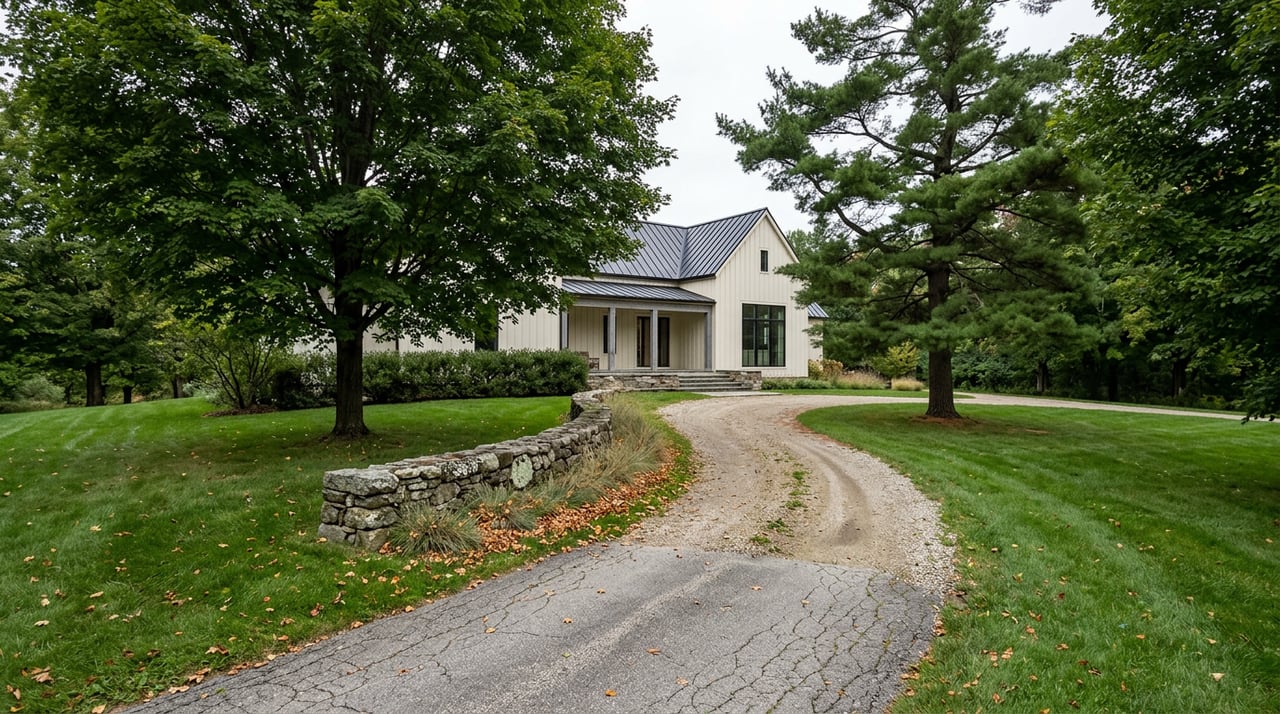
A buyer who has spent a weekend touring Canton and Avon before crossing into Burlington usually notices the same thing before they ever get inside a house: the last quarter mile is different. In Canton and Avon, most listings sit close enough to the road that you can see the front door from the car. In Burlington, you often turn off the pavement and keep driving.
That difference doesn't show up in a listing sheet. It shows up in the price.
The numbers say Burlington and Avon are practically neighbors
Look at the raw price-per-square-foot figures from this year and Burlington doesn't read like the region's most rural town. In June 2026, Burlington homes carried a median list price of $689,900, working out to roughly $253 per square foot, with homes going under contract in a median of 17 days, down from 23 days the year before. Avon, in July 2026, posted a median list price of $649,000 at about $242 per square foot, with homes moving in a median of 15 days. Canton, the most walkable of the three around its Collinsville village core, posted a median sale price of $512,000 in March 2026 at roughly $219 per square foot, selling in a median of just 7 days.
Set those side by side and something doesn't line up. Burlington, the town with the fewest sidewalks and the longest commute to a Whole Foods, is pricing at or above two more built-up neighbors on a strict dollar-per-square-foot basis. If the house were the only thing being priced, that shouldn't happen.
It isn't the only thing being priced.
What the square footage doesn't count
Burlington's zoning code sets its baseline residential lot size, the R-44 zone, at 43,560 square feet. That number isn't arbitrary. It's exactly one acre, spelled out in the definitions section of the town's own zoning regulations. Every home built to that baseline standard is carrying an acre of land as a starting condition, not an upgrade.
An acre lot in a town with Burlington's road network usually means one more thing: distance between the house and the street the town actually maintains. And Burlington's zoning code treats that distance as serious enough to give it its own real estate within the document. Two full appendices are devoted to nothing else.
Appendix D, Burlington Specifications for Driveways. Appendix E, Driveway Permit Regulations.
Most town zoning codes fold driveway rules into a general site development section. Burlington gave the subject its own chapters. That's a tell. When a town writes that much regulation around one feature, it's because that feature comes up constantly, and here it comes up because so many homes sit behind a private drive rather than fronting a curb.
The permit question that follows the buyer home
Connecticut treats a driveway connection as a regulated act, not paperwork you file after the fact. Whether the review authority is the state or the town depends on what the driveway connects to. If it ties into a state highway, the Connecticut Department of Transportation reviews the design under state statute. If it ties into a town road, which describes most of Burlington's network, the review sits with the town instead. Either way, new construction, a widened drive, or a relocated entrance triggers the process. A driveway that already exists and isn't being altered generally isn't pulled back through it.
That distinction matters for a buyer weighing an acre-plus lot in Burlington against a smaller, curb-fronted lot in Canton or Avon. On the smaller lot, the driveway is usually a short paved apron that was never a design question. On the larger lot, the driveway is graded, culverted, and drained to a town standard, and if any of that work is still ahead of you, it's a cost that never appeared on the comparable-sales sheet.
Then there's the road itself
Some of Burlington's longer drives aren't really driveways at all. They're private lanes serving more than one house, and Connecticut law is specific about who's on the hook for keeping them up. A 2003 legislative research report lays out the options: a road can be formally dedicated and accepted by the town, a court can find it was treated as public even without formal paperwork, or the owners can simply pay for it themselves, usually by forming a homeowners association or a special taxing district. Absent the first two, the third is where most shared rural lanes land.
That means a recorded maintenance agreement, or the lack of one, is a real fact about the property, not a formality. A buyer touring a home at the end of a shared lane in Burlington should ask whether that agreement exists before falling for the setting.
What raw land in Burlington shows you directly
The pattern isn't theoretical. Land currently listed in town regularly comes to market with septic design and site clearing already completed, because in a town built around acre-plus parcels, those steps are a precondition of building, not a finishing touch a buyer adds later. A parcel that's already been engineered and cleared is worth more precisely because someone has already absorbed the cost that a buyer in a smaller-lot town would never have had to think about at all.
None of this means Burlington is overpriced relative to Canton or Avon. It means the per-square-foot number is doing less work than it looks like it's doing. Part of what a Burlington buyer is paying for is the acre, the graded and permitted access to it, and in some cases the site work that already happened before the sign went in the yard.
Before you tour, ask these
If you're comparing a Burlington listing against something in Canton or Avon on price alone, a few questions close the gap between the number and the reality:
- Is the driveway already permitted under the town's current Appendix D and E standards, or does it predate them?
- Does the road serving the house belong to the state, the town, or is it an unaccepted private lane?
- If it's private, is there a recorded maintenance agreement, and who is party to it?
- When was the septic system designed, and does that design account for any addition you're picturing?
Every one of those answers is knowable before you write an offer. None of them show up in a portal search.
FAQ
Does every home in Burlington need a driveway permit? No. The requirement is triggered by new construction, widening, or relocating a driveway's connection to a road. An existing driveway on a home you're not altering typically isn't pulled back through the process.
Is a private road a warning sign? Not by itself. Plenty of Burlington's private lanes are well kept and function without issue. The thing to verify isn't the private status, it's the documentation behind it.
Does this apply the same way in Canton and Avon? Less often, simply because more of the housing stock in those towns sits on smaller, curb-fronted lots where the driveway was never a design question to begin with. It's a Burlington-shaped issue because Burlington is built on acre-plus zoning.
If you're weighing Burlington against Canton or Avon and want someone to actually read the driveway permit history and the road status before you tour, that's the kind of homework Laurie Kane Real Estate does before a client ever sees a listing sheet. Whether you're comparing towns as a buyer or thinking about what a larger Burlington lot could mean for a future sale, request your complimentary CMA and staging consultation and we'll walk the acre with you, not just the square footage.